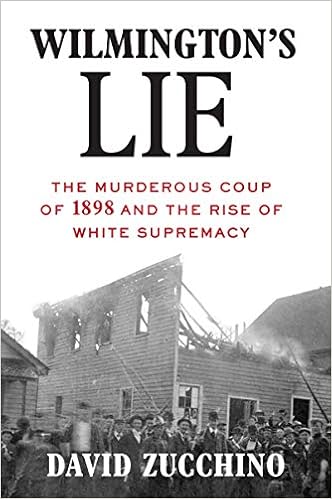
Wilmington had started the Reconstruction Era heading in the right direction. When other Southern cities were seeing the rise of groups like the Ku Klux Klan, a former escaped slave named Abraham Galloway decided that was not going to happen in his town. Galloway had been a Union spy during the Civil War, and he was currently serving as a state senator, and was a leader in the fight for black rights in eastern North Carolina. He formed a black militia and ran the Ku Klux Klan out of his town in 1868. His courage and determination contributed to Wilmington becoming a unique experiment for nearly 30 years before it would all come crashing down.
When black men won the right to vote in North Carolina in 1868 about 80,000 of them registered to vote, and became active in the politics of North Carolina. But by 1900 two white supremacy campaigns had cut that number down to only 15,000 in the entire state, and it's like that less than half of that number actually voted that year. For the first time since the end of the Civil War, not a single black man was elected to the North Carolina house or senate in the 1900 election. After a generation of freedom and liberty, the time of Jim Crow had arrived.
By 1900 white supremacist Democrats had seized control of North Carolina's largest city, its capital, the legislature, the governor's mansion and one of the US Senate seats. Black were thrown out of the voting booth and public office. Segregation was now the law of the land. And to guarantee that all of this would continue, the most influential newspaper in North Carolina regularly published its propaganda of the glories and benefits of white rule.
The Revolution of 1898 in Wilmington had proven that white's could beat down the black vote (both literally and figuratively), and that they could defeat black office holders through a campaign of terror, violence and make it all nice and legal through legislation. And to make it all even better it had shown that the Federal government was either powerless or reluctant to do anything about it. The success of the Wilmington 1898 campaign led to the establishment of North Carolina's first Jim Crow laws, and it encouraged other southern states to follow - Alabama in 1901, Virginia in 1902, Georgia in 1908, and Oklahoma in 1910.
It is disturbing how quickly these changes took place. In 1896 there were 126,000 black voters in the state of North Carolina, in 1902, just four years after the Wilmington Revolt, there were only 6,100. It would not be until the 1950s before blacks would vote in large numbers again.
Wilmington, NC, went from being a mecca for blacks - a place where they could live in safety, prosper and own property and businesses, live in the same neighborhoods as whites - to being a citadel of white supremacy. The events of 1898 forever destroyed the black population and culture of the city as well. The 1900 census records show that Wilmington was 49% black, and it would go down from there. As recently as 2018, blacks only made up 18.3% of the population.
You would think that such a tragic event would be well-known throughout the Carolinas, but despite having been a history nerd since I was 8, growing up in South Carolina, just to the southwest of Wilmington, and spending almost my entire adult life in North Carolina, I had never heard of this until 2006. 2006 was the year that the North Carolina state legislature concluded its six year long investigation into the events of Wilmington. And I'm not a lone in my lack of knowledge of this tragedy. Most people who were ever taught about it in school were told a myth about 1898, and North Carolina textbooks have spent the last 120 years ensuring that that is the myth that endures and would be passed down to each new generation of kids. For many years the state produced two separate textbooks - one for white-dominate schools, and another for black-dominate schools. It wasn't until 1951 before any historians in North Carolina would dare to challenge the narrative, but since that was done by a black woman, no one took her seriously.
This is why I think Wilmington's Lie is so important. I think everyone who has lived or currently lives in the Carolinas should read this book. No matter where in the United States you live, this is an important book because it tells of the beginning of a terrible era in our history.
Recently there has been a lot of discussion over Tulsa, Chicago and other 'race riots', and that is good, but Wilmington is only referred to in passing at best. I think it is doubtful that these other events would have happened or been as horrific if not for the 'success' of Wilmington. Jim Crow came into being in Wilmington, and swept across the Carolinas and the rest of the South and the entire United States.David Zucchino has put together a cohesive narrative of the events leading up to, during, and after November 1898. He explains the causes, tells the horrific actions, and the tragic aftermath. And he manages to do all of this in a very readable way. This is not a happy story. There is no satisfying conclusion. This is a heavy book in that it deals with a dark, disturbing series of events.
It's really a fast-paced narrative. The only reason it took me about 2 months to read was because my library loan expired and I had to wait a month to get it back.
